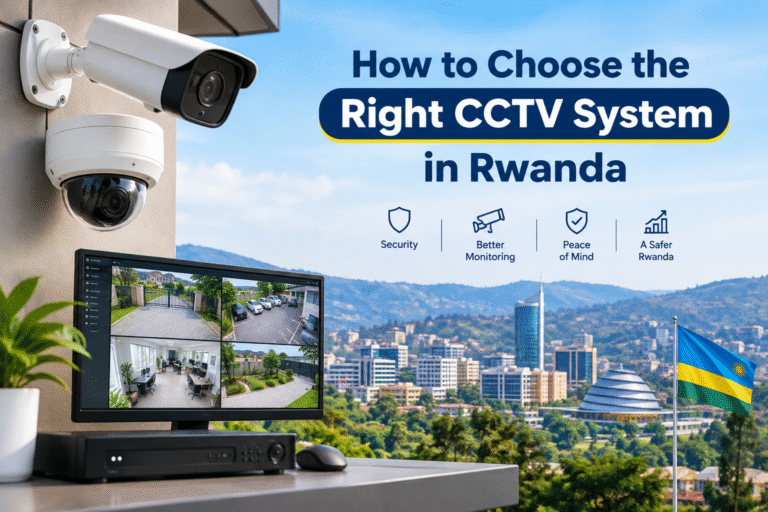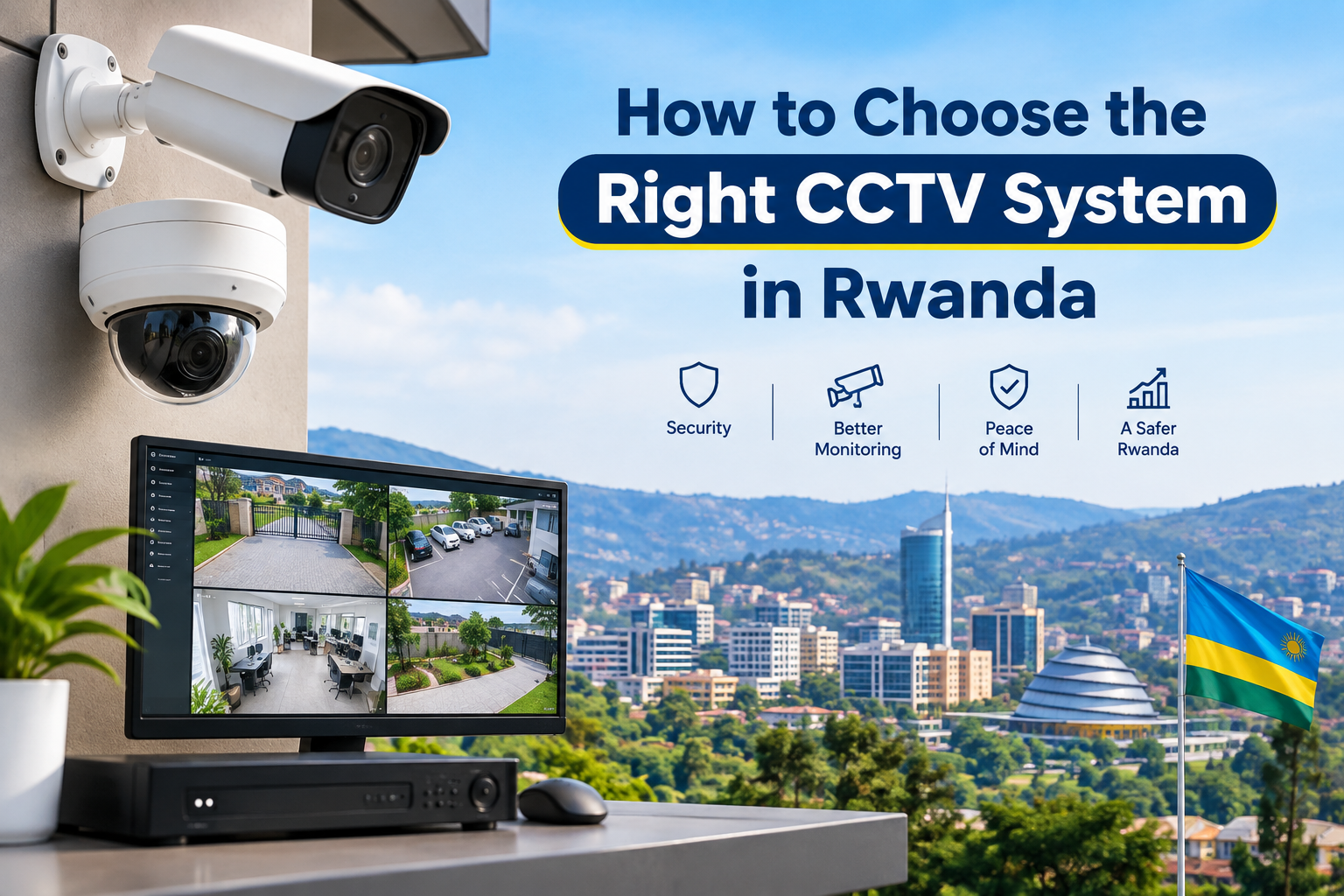
How to Choose the Right CCTV System in Rwanda
Security has become an important priority for homes, businesses, offices, schools, warehouses, hotels, retail stores, and other properties across Rwanda. A properly designed surveillance system can help deter unwanted activity, monitor important areas, protect employees and customers, and provide useful video evidence when an incident occurs.
However, choosing the right CCTV system in Rwanda is not simply about buying the camera with the highest megapixel rating or the lowest price. A reliable surveillance solution needs to match your property, security risks, lighting conditions, storage requirements, internet infrastructure, and budget.
Whether you are securing a small home in Kigali, a retail shop, an office, a warehouse, or a larger commercial facility, this guide explains the most important factors to consider before purchasing and installing CCTV cameras.
Why Is CCTV Important in Rwanda?
CCTV systems provide continuous visual monitoring of important areas. Depending on the design, cameras can monitor entrances, parking areas, corridors, reception areas, warehouses, cash counters, gates, and outdoor spaces.
For businesses, CCTV can provide an additional layer of security while helping management understand what is happening across different parts of a property.
For homeowners, cameras can help monitor entrances, driveways, compounds, and other vulnerable areas.
A modern CCTV system in Rwanda can also offer features such as remote viewing, motion detection, night vision, video recording, mobile notifications, and intelligent video analytics.
The key is to select a system based on your actual security requirements rather than simply purchasing the most expensive equipment.
1. Start With a Security Assessment
Before selecting cameras, identify what you want your CCTV system to achieve.
Ask yourself:
- Which areas need monitoring?
- Are the cameras required indoors, outdoors, or both?
- Do you need 24/7 recording?
- Are there areas with poor lighting?
- Do you need to identify people’s faces?
- Do you need to read vehicle number plates?
- How long should recordings be stored?
- Do you need remote monitoring from a smartphone?
- How many people will have access to the recordings?
For example, a small home may only need cameras covering the main entrance, compound, gate, and parking area. A warehouse may require considerably more cameras to cover loading areas, storage sections, entrances, and perimeter zones.
A professional site assessment helps prevent blind spots and unnecessary camera purchases.
2. Choose the Right CCTV Camera Type
There are several types of CCTV cameras available, and each has a different purpose.
Dome Cameras
Dome cameras are compact and often used indoors. Their discreet appearance makes them suitable for:
- Offices
- Shops
- Hotels
- Schools
- Reception areas
- Retail stores
They can provide a clean and professional appearance while covering important indoor areas.
Bullet Cameras
Bullet cameras are commonly used for outdoor surveillance. Their design makes them suitable for monitoring:
- Gates
- Parking areas
- Building entrances
- Perimeters
- Roads and driveways
When choosing outdoor cameras, check their weather resistance and environmental protection rating.
PTZ Cameras
PTZ means Pan, Tilt and Zoom. These cameras can move horizontally and vertically and can zoom into specific areas.
PTZ cameras can be useful for large properties such as:
- Warehouses
- Industrial facilities
- Large compounds
- Parking facilities
- Commercial properties
However, a PTZ camera should not automatically replace fixed cameras. Fixed cameras can continuously monitor specific areas while a PTZ camera provides flexible coverage.
3. Decide Between Analog and IP CCTV
One of the most important decisions when selecting a CCTV system in Rwanda is whether you need an analog HD system or an IP-based system.
Analog CCTV
Traditional analog systems typically use coaxial cables to connect cameras to a DVR.
They can be suitable when:
- You need a straightforward surveillance system.
- Existing coaxial cabling is available.
- The installation budget is limited.
- You do not require advanced networking features.
IP CCTV
IP cameras transmit video through a network and normally connect to an NVR or network infrastructure.
They can offer advantages such as:
- Higher-resolution video
- Network connectivity
- Remote access
- Easier system expansion
- Advanced analytics
- Power over Ethernet (PoE) options
For new commercial installations, IP CCTV can be an attractive option because it provides flexibility for future upgrades.
The best choice depends on the property and installation requirements rather than simply choosing whichever technology is newer.
4. Select the Appropriate Camera Resolution
Resolution determines how much visual detail a camera can capture.
Common CCTV resolutions include:
- 2MP
- 4MP
- 5MP
- 8MP / 4K
- Higher-resolution specialist cameras
Higher resolution can provide more detail, but it also generally requires more storage and network bandwidth.
For example, a camera monitoring a general corridor may not need the same resolution as a camera positioned to identify people entering a secure facility.
When choosing a CCTV system in Rwanda, think about what you need to see rather than simply choosing the highest resolution available.
If facial identification, license-plate recognition, or detailed monitoring is important, discuss the required camera positioning and lens selection with an experienced installer.
5. Consider Night Vision and Low-Light Performance
Security incidents can happen at any time, so nighttime performance is extremely important.
Look for cameras that provide reliable low-light performance and infrared night vision when required.
However, simply seeing that a camera has “night vision” does not guarantee excellent nighttime footage.
Consider:
- Infrared range
- Low-light sensitivity
- Image quality at night
- Nearby lighting
- Camera positioning
- Reflective surfaces
For outdoor installations, test how the camera performs under actual nighttime conditions.
A camera that produces excellent daytime footage but poor nighttime images may not provide the level of protection you expect.
6. Choose the Correct Lens and Field of View
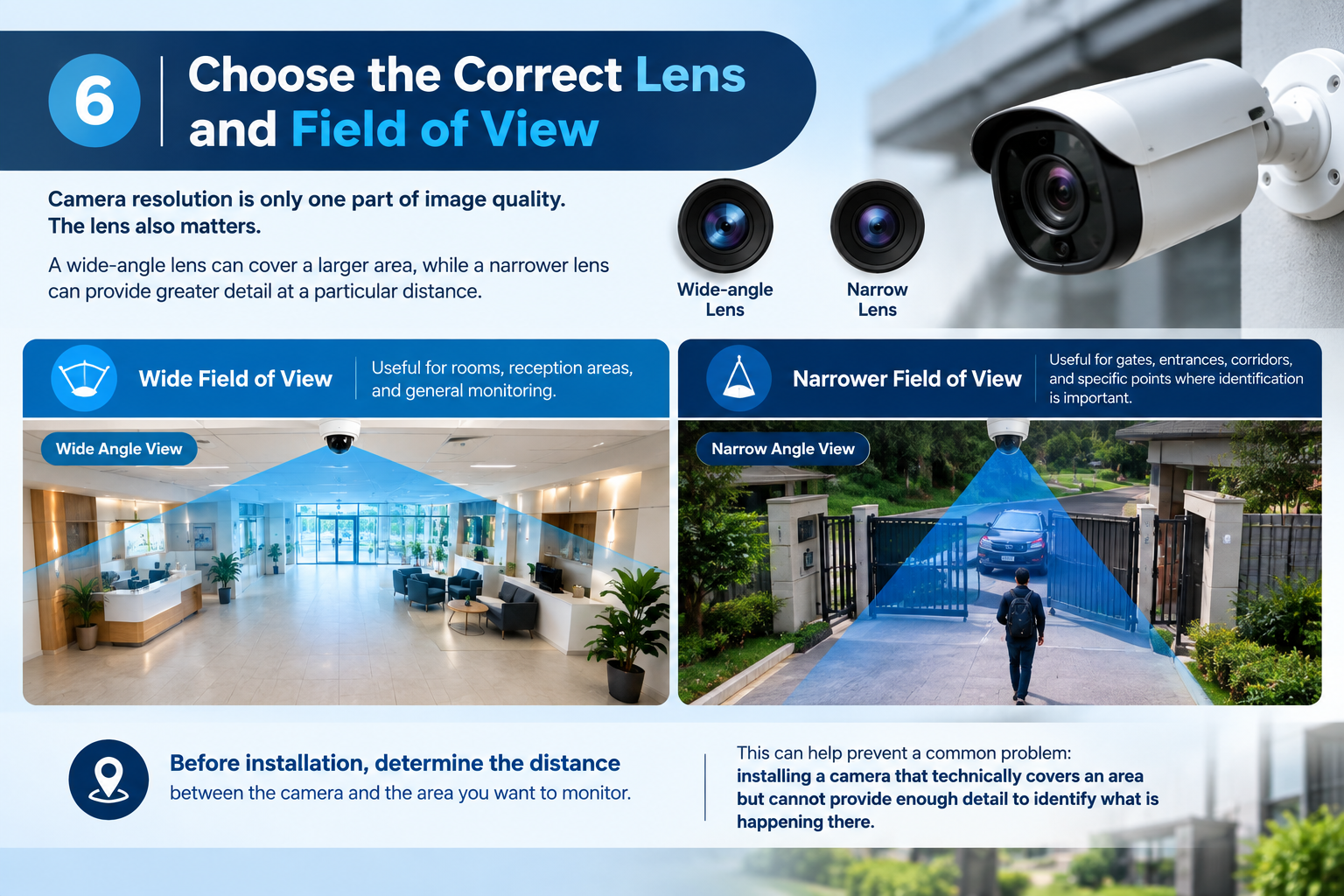
Camera resolution is only one part of image quality. The lens also matters.
A wide-angle lens can cover a larger area, while a narrower lens can provide greater detail at a particular distance.
For example:
Wide field of view:
Useful for rooms, reception areas, and general monitoring.
Narrower field of view:
Useful for gates, entrances, corridors, and specific points where identification is important.
Before installation, determine the distance between the camera and the area you want to monitor.
This can help prevent a common problem: installing a camera that technically covers an area but cannot provide enough detail to identify what is happening there.
7. Check Storage Requirements
A CCTV system is only useful if important recordings are available when you need them.
Storage requirements depend on several factors:
- Number of cameras
- Resolution
- Frame rate
- Recording schedule
- Compression technology
- Motion detection
- Required retention period
For example, a system recording 20 cameras continuously at high resolution will require significantly more storage than a small system recording four cameras based mainly on motion detection.
You should decide how many days of footage you want to retain.
A professional installer can calculate the approximate storage requirement based on your cameras and recording settings.
8. Choose DVR or NVR Carefully
The recorder is an important component of your surveillance system.
DVR
A DVR is generally used with analog cameras.
NVR
An NVR is generally used with IP cameras.
When selecting a recorder, check:
- Number of supported cameras
- Maximum recording resolution
- Storage capacity
- Hard-drive compatibility
- Remote viewing capabilities
- Network ports
- Backup options
- AI or analytics support
Do not purchase a recorder based only on the number of camera channels. Make sure it can handle the resolution and bandwidth requirements of all cameras.
9. Think About Remote CCTV Monitoring
Modern surveillance systems can allow authorized users to view cameras remotely through smartphones, tablets, or computers.
This can be particularly useful for business owners who need to monitor their property while away from the premises.
For example, a business owner may want to check:
- Store entrances
- Cash counters
- Office areas
- Warehouse activity
- Parking areas
- Delivery zones
However, remote access should be configured securely.
Use strong passwords, limit user permissions, keep firmware updated, and avoid sharing administrator credentials unnecessarily.
A well-designed CCTV system in Rwanda should provide convenience without creating unnecessary cybersecurity risks
.
10. Don’t Ignore Internet and Network Requirements
IP cameras depend on network infrastructure, so network planning is important.
Before installation, consider:
- Ethernet cabling
- Network switches
- PoE switches
- Router capacity
- Internet connection
- Wi-Fi limitations
- Remote access requirements
For many professional installations, wired Ethernet connections are preferable because they can provide stable connectivity and Power over Ethernet.
Wireless cameras can be useful in certain situations, but they should not automatically be considered the best option for every property.
11. Choose Weather-Resistant Outdoor Cameras
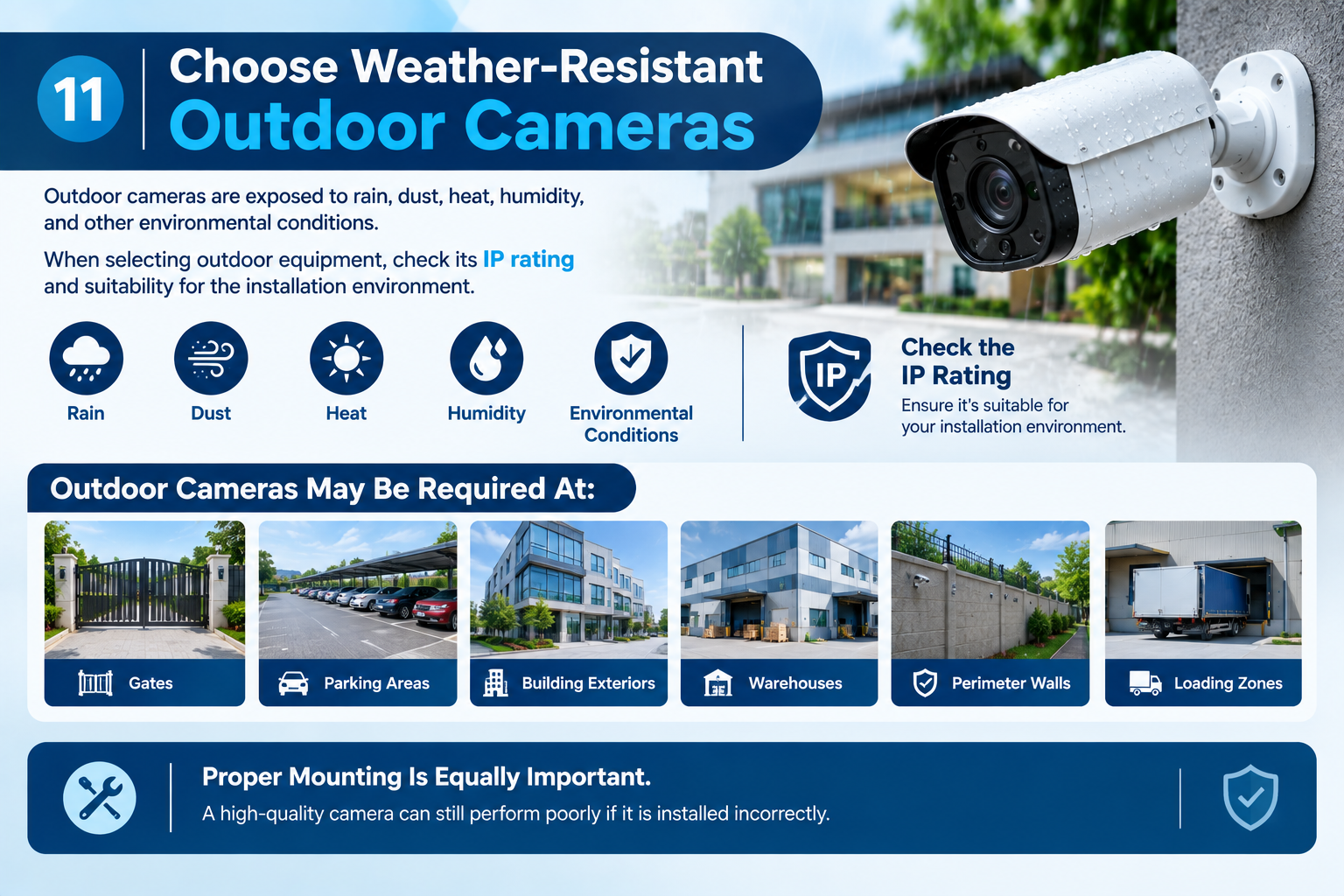
Outdoor cameras are exposed to rain, dust, heat, humidity, and other environmental conditions.
When selecting outdoor equipment, check its IP rating and suitability for the installation environment.
Outdoor cameras may be required at:
- Gates
- Parking areas
- Building exteriors
- Warehouses
- Perimeter walls
- Loading zones
Proper mounting is equally important. A high-quality camera can still perform poorly if it is installed in an unsuitable position or exposed unnecessarily to environmental conditions.
12. Consider CCTV Privacy and Rwanda’s Data Protection Requirements
Privacy should be an important part of any surveillance project.
Rwanda’s Personal Data Protection and Privacy Law applies to the processing of personal data, and the Data Protection & Privacy Office specifically identifies security companies operating CCTV systems among relevant activities.
The law requires personal data to be processed lawfully, fairly, and transparently, and organizations must take appropriate technical measures to protect personal data.
Rwanda’s building regulations also address CCTV systems. The Rwanda Building Code states that CCTV should not violate privacy rights, surveillance areas should have appropriate signage, and cameras should not be installed in locations where people have a reasonable expectation of privacy, such as washrooms and changing rooms.
Therefore, before installing a CCTV system in Rwanda, businesses should consider:
- Where cameras are positioned
- Why surveillance is necessary
- Who can access recordings
- How recordings are stored
- How long recordings are retained
- Whether appropriate notices are provided
- Whether the organization has applicable data-protection obligations
For official information, consult the Rwanda Data Protection & Privacy Office and review its guidance before implementing a large surveillance project.
13. Select a Reliable CCTV Installation Company
Buying good cameras is only part of the project.
Installation quality can significantly affect system performance.
A professional installer should be able to help with:
- Site assessment
- Camera positioning
- Cable planning
- Network configuration
- Recorder setup
- Storage calculations
- Remote access
- Testing
- Maintenance
- User training
When comparing CCTV installation companies in Rwanda, ask about their experience, previous installations, warranty arrangements, technical support, and ability to maintain the system after installation.
You can also ask for a detailed quotation showing the camera models, recorder, storage, cabling, installation costs, configuration, and warranty.
The Data Protection & Privacy Office recommends due diligence when selecting data processors, including considering their trustworthiness, capabilities, security measures, and registration where required.
14. Don’t Choose CCTV Based Only on Price
Price is naturally an important consideration, but the cheapest CCTV system may not always be the most economical option.
A low-cost system may have:
- Poor nighttime performance
- Limited storage
- Weak network security
- Low-quality components
- Shorter lifespan
- Limited technical support
Instead of asking only, “How much does the camera cost?” consider the total cost of ownership.
This includes:
- Cameras
- Recorder
- Hard drives
- Cabling
- Network equipment
- Installation
- Configuration
- Maintenance
- Replacement costs
- Possible future expansion
A slightly higher initial investment in a properly designed system can provide better value over its operating life.
15. Plan for Future Expansion
Your security requirements may grow over time.
Perhaps you initially need eight cameras but may later add cameras to a new building, parking area, warehouse, or additional entrance.
Choose equipment that can accommodate reasonable future expansion.
For example, instead of purchasing an NVR that supports exactly eight cameras when you already expect to expand, you might consider a higher-capacity recorder if the budget and project requirements justify it.
Future-proofing can save installation costs later.
CCTV System Checklist for Rwanda
Before purchasing your surveillance equipment, use this checklist:
| Requirement | What to Check |
|---|---|
| Property size | Number of areas requiring coverage |
| Camera type | Dome, bullet, PTZ, etc. |
| Resolution | 2MP, 4MP, 5MP, 4K, etc. |
| Night vision | IR and low-light performance |
| Lens | Required field of view |
| Recorder | DVR or NVR |
| Storage | Required retention period |
| Network | Ethernet, PoE, switches |
| Remote access | Mobile and computer viewing |
| Outdoor protection | Weather-resistant rating |
| Privacy | Camera positioning and notices |
| Security | Passwords, access controls and updates |
| Installation | Professional configuration |
| Support | Warranty and maintenance |
| Expansion | Future camera capacity |
What Is the Best CCTV System for a Home in Rwanda?
A home usually does not need the same surveillance infrastructure as a large commercial facility.
A typical residential setup might include cameras covering:
- Main gate
- Front entrance
- Parking area
- Backyard or compound
- Side entrances
For a home, important features can include night vision, motion detection, mobile notifications, two-way audio where appropriate, and remote viewing.
The final camera count should depend on the property’s layout and security requirements.
What Is the Best CCTV System for a Business?
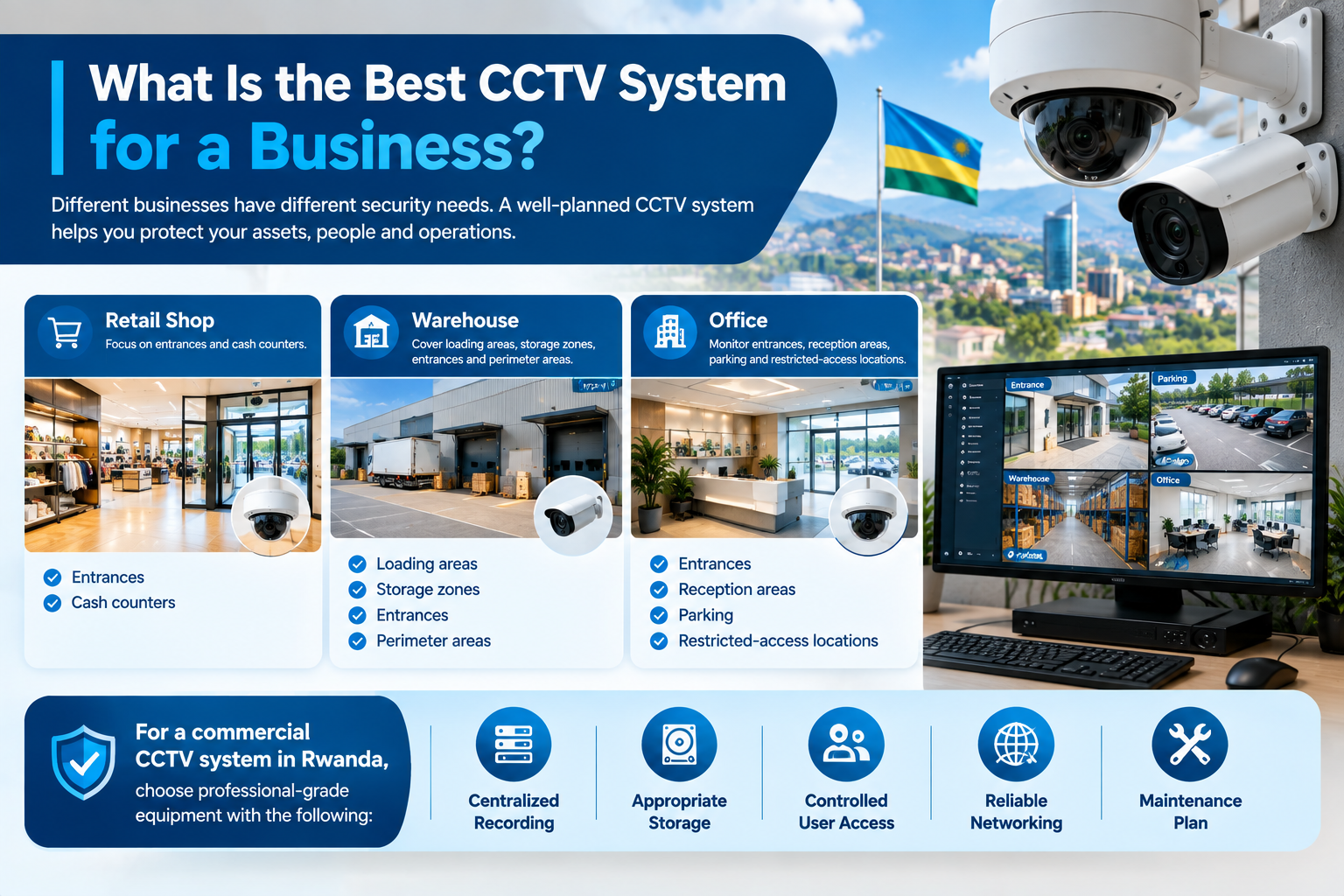
Businesses generally require a more carefully planned system.
A retail shop may prioritize entrances and cash counters, while a warehouse may need coverage of loading areas, storage zones, entrances, and perimeter areas.
An office may require cameras around entrances, reception areas, parking, and restricted-access locations.
For a commercial CCTV system in Rwanda, consider using professional-grade equipment with centralized recording, appropriate storage, controlled user access, reliable networking, and a maintenance plan.
Common CCTV Mistakes to Avoid
Avoid these common mistakes when designing your surveillance system:
1. Installing Too Few Cameras
Too few cameras can create blind spots.
2. Ignoring Nighttime Conditions
A camera that performs well during daylight may not provide useful images at night.
3. Buying the Highest Resolution Without Planning
Higher resolution can increase storage and bandwidth requirements.
4. Poor Camera Positioning
Even an expensive camera cannot compensate for an unsuitable viewing angle.
5. Weak Passwords
Default or easily guessed credentials can create security risks.
6. No Backup Plan
Important recordings should be protected against equipment failure and other risks.
7. Ignoring Privacy
Surveillance should be designed with applicable privacy and data-protection obligations in mind.
8. Choosing an Installer Based Only on Price
Poor installation can reduce the effectiveness of even high-quality equipment.
Final Thoughts: How to Choose the Right CCTV System in Rwanda
Choosing the right surveillance solution requires more than comparing camera prices. You should evaluate the property’s layout, security risks, lighting conditions, camera type, resolution, storage, networking, remote access, privacy requirements, installation quality, and future expansion.
The ideal CCTV system in Rwanda is one that provides the right level of coverage and image quality for your specific environment while remaining secure, reliable, maintainable, and compliant with applicable requirements.
Before making a final purchase, compare different equipment options, request a professional site assessment, calculate storage requirements, and ask the installer about warranty and technical support.
For additional guidance on privacy and CCTV-related data protection, consult the official Data Protection & Privacy Office of Rwanda, which provides information about Rwanda’s personal data protection framework.
A good CCTV investment is not simply about having more cameras—it is about having the right cameras, in the right locations, configured and secured correctly.