How a Modern CCTV System Can Reduce Operational Risk and Wasted Time
Introduction
Businesses face many operational challenges every day, including theft, unauthorized access, workplace accidents, inventory losses, employee safety concerns, and delays in daily activities. These problems can affect productivity, increase operating costs, and prevent managers from focusing on important business goals. Without reliable monitoring, identifying the cause of an incident may take hours or even days.
A modern CCTV system provides businesses with a practical way to improve visibility, strengthen security, and manage daily operations more efficiently. Unlike basic surveillance cameras, modern solutions can include high-definition recording, remote monitoring, motion detection, intelligent video analytics, and integration with access control systems.
These technologies help business owners identify potential problems, review incidents, and make informed decisions using recorded evidence. They can also reduce the time employees spend investigating complaints, checking stockrooms, and manually monitoring multiple areas.
Whether you operate a retail store, warehouse, office, factory, healthcare facility, or commercial building, a well-planned surveillance solution can support safer and more organized operations.
In this guide, we explain how CCTV technology helps reduce operational risks, minimize wasted time, improve workplace safety, and support long-term business efficiency.
1. Understanding Operational Risk in Modern Businesses
Operational risk refers to the possibility of losses or disruptions caused by people, processes, equipment, or external events. These risks can affect businesses of every size and industry.
For example, a retail store may experience inventory theft, while a warehouse may face loading delays or unauthorized entry. An office may struggle with visitor management, and a manufacturing facility may need better visibility into potentially hazardous work areas.
Common operational risks include:
- Theft of products, equipment, and company assets.
- Unauthorized access to restricted locations.
- Workplace accidents and unsafe activities.
- Disputes involving employees, customers, or visitors.
- Inefficient workflows and unnecessary delays.
- Poor accountability for deliveries and inventory handling.
- Security incidents that are difficult to investigate.
- Unexpected downtime caused by unresolved problems.
These challenges often become more expensive when businesses cannot identify them quickly.
A modern CCTV system can help address these issues by providing visual information about activities across important business locations. Managers can review relevant footage, identify weaknesses in existing procedures, and take corrective action before similar problems occur again.
However, surveillance should be considered one component of a wider risk-management strategy rather than a replacement for staff training, physical security, safety procedures, or proper supervision.
2. Preventing Theft and Reducing Financial Losses
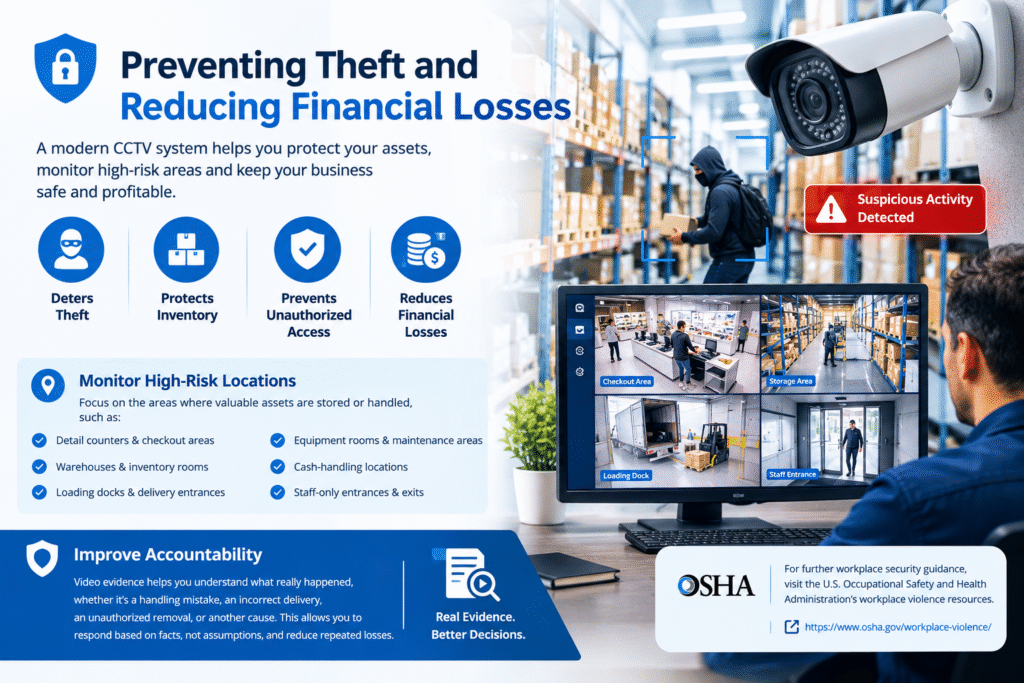
Theft and unauthorized handling of assets can create significant financial problems for businesses. Products may disappear from shelves, equipment may be removed without approval, or stock discrepancies may remain unexplained for weeks.
Visible cameras can discourage some opportunistic theft by increasing the likelihood that suspicious activities will be detected. Recorded footage can also help investigators establish what happened when a loss occurs.
Monitoring high-risk locations
Businesses should identify areas where valuable assets are stored or handled. Depending on the premises, these may include:
- Retail counters and checkout areas.
- Warehouses and inventory storage rooms.
- Loading docks and delivery entrances.
- Equipment rooms and maintenance areas.
- Cash-handling locations.
- Staff-only entrances and exits.
Camera placement should provide useful views of relevant activities without leaving important areas obstructed by shelves, machinery, or structural features.
For example, a warehouse manager investigating missing inventory may review footage from the storage aisle, dispatch area, and loading dock to establish when an item was moved.
Improving accountability
Video evidence can help clarify whether a discrepancy resulted from a handling mistake, an incorrect delivery, an unauthorized removal, or another cause.
This allows management to respond based on evidence rather than assumptions. It can also help identify weaknesses in inventory procedures and reduce repeated losses.
For further workplace security guidance, businesses can consult the U.S. Occupational Safety and Health Administration’s workplace violence resources, which discuss workplace risks and preventive measures.
3. Saving Time Through Faster Incident Investigation
Investigating workplace incidents manually can consume valuable employee hours. Managers may need to interview several people, inspect records, compare delivery information, and reconstruct a sequence of events from incomplete details.
A reliable surveillance solution makes this process more straightforward.
Instead of relying entirely on memory or written statements, authorized staff can review relevant recordings to establish what happened and when.
Faster access to recorded evidence
Modern recording systems may offer searchable timelines, event markers, motion-based playback, and filters that help users locate relevant footage.
For example, if a customer reports that a product was damaged during delivery, a supervisor may review footage from the receiving area around the reported time. This can help establish whether the damage occurred during unloading, storage, or another stage of handling.
Similarly, if an employee reports a workplace accident, the relevant recording may help investigators understand the surrounding circumstances.
Reducing unnecessary meetings
Clear visual evidence can reduce repeated questioning and avoid prolonged disagreements about straightforward incidents. Staff can concentrate on resolving the problem instead of spending excessive time reconstructing events.
The time saved will depend on recording quality, camera coverage, retention periods, and how efficiently the system can locate relevant footage.
Businesses should establish clear procedures for exporting, preserving, and sharing recordings when an incident requires formal investigation.
4. Improving Employee Safety and Workplace Security
Employee safety is essential for maintaining stable operations. Unsafe working conditions, confrontations, unauthorized visitors, and poorly monitored areas can expose employees to avoidable risks.
A CCTV installation can improve visibility in locations where direct supervision is difficult. Cameras may be useful around reception areas, entrances, corridors, parking facilities, loading zones, and other locations identified during a workplace risk assessment.
Identifying unsafe activities
Recorded footage can help safety managers understand how incidents develop. For example, a manager may discover that workers regularly cross a forklift route without adequate separation or that equipment is frequently left in an emergency exit pathway.
This information can support improvements to workplace layout, staff training, warning signs, and operational procedures.
Supporting incident response
When cameras are integrated with appropriate alarm systems and security procedures, staff may be able to identify an incident and contact the responsible response team more quickly.
However, cameras do not automatically prevent accidents or guarantee immediate assistance. Monitoring responsibilities, escalation procedures, and emergency contacts must be clearly established.
The OSHA workplace violence overview provides additional information about workplace risk factors and the importance of prevention programs.
5. Reducing Wasted Time in Daily Operations
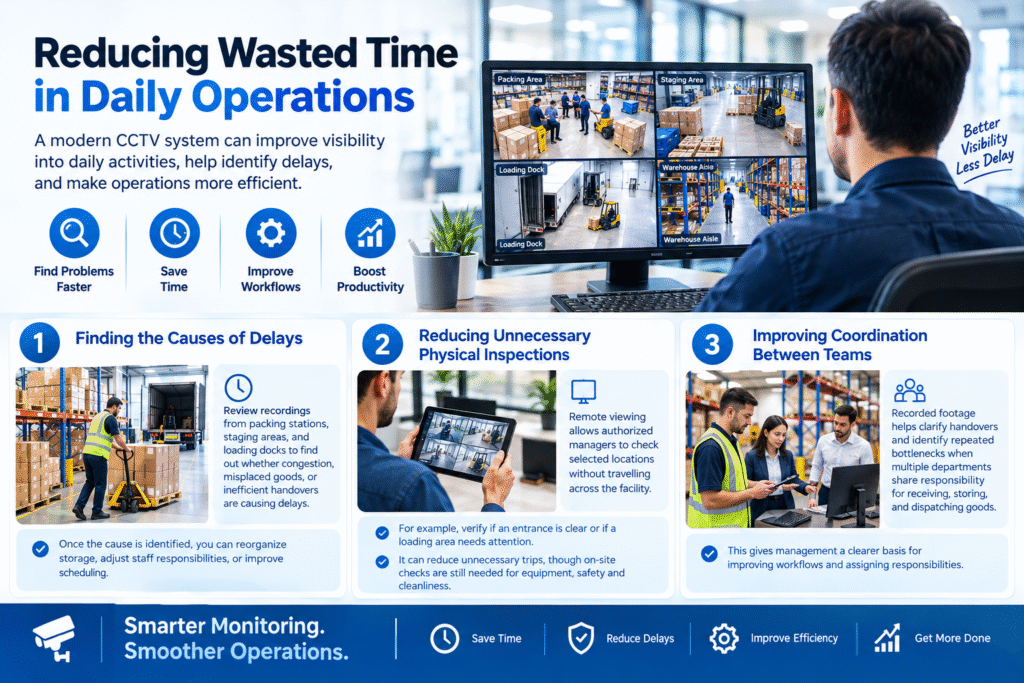
Wasted time often results from small operational problems that occur repeatedly. Employees may spend time searching for misplaced items, checking multiple locations, confirming deliveries, or waiting for managers to resolve disagreements.
A modern CCTV system can improve visibility into these activities and help managers understand where delays occur.
Finding the causes of delays
Consider a distribution warehouse where outgoing shipments regularly leave late. Management may review recordings from packing stations, staging areas, and loading docks to determine whether congestion, misplaced goods, or inefficient handovers contribute to the problem.
Once the cause is identified, the business can reorganize storage, adjust staff responsibilities, or improve scheduling.
Reducing unnecessary physical inspections
Remote viewing allows authorized managers to check selected locations without travelling across a large facility.
For example, a facilities manager responsible for several buildings may be able to verify whether an entrance is clear or whether a loading area requires attention from a central workstation.
Remote viewing does not replace every physical inspection, particularly when equipment condition, cleanliness, or workplace safety must be checked directly. It can, however, reduce unnecessary trips when a visual check is sufficient.
Improving coordination between teams
When several departments share responsibility for receiving, storing, and dispatching goods, recorded footage can help clarify handovers and identify repeated bottlenecks.
This gives management a clearer basis for improving workflows and assigning responsibilities.
6. Using Intelligent Video Analytics to Identify Problems
Traditional CCTV systems primarily record footage for later review. Newer systems may include video analytics that automatically identify selected events or unusual patterns.
Depending on the equipment and configuration, these features can include motion detection, line-crossing alerts, intrusion detection, loitering alerts, people counting, and vehicle detection.
Automated alerts
For example, an intrusion rule may notify authorized personnel when activity is detected inside a restricted zone outside approved operating hours.
A warehouse system may generate an alert when movement occurs near a sensitive storage area during a defined period.
These notifications can help staff prioritize important events rather than continuously watching every camera feed.
Reducing false alarms
Analytics are not always accurate. Poor lighting, moving shadows, reflections, weather conditions, and incorrect detection settings can create unnecessary alerts.
Businesses should test detection rules in real operating conditions and adjust sensitivity to suit the environment. Human verification may still be necessary before taking action.
Supporting better operational decisions
People-counting and occupancy analytics can help businesses understand how spaces are used. Retail managers, for example, may compare visitor traffic with staffing schedules to identify periods when additional assistance could improve customer service.
Such information should be interpreted carefully and combined with other operational data rather than treated as a complete measure of employee performance.
7. Strengthening Access Control and Visitor Management
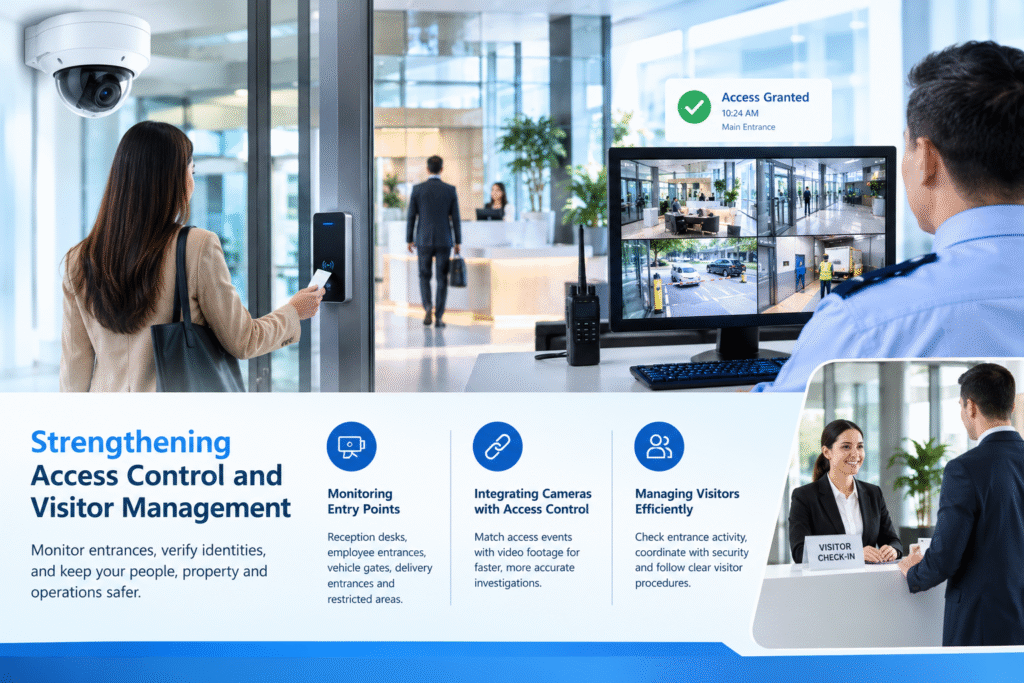
Unauthorized access can expose businesses to theft, information loss, safety incidents, and operational disruption.
A modern surveillance solution can support entrance monitoring by showing who enters or leaves designated areas and helping authorized staff verify suspicious activity.
Monitoring entry points
Useful camera locations may include reception desks, employee entrances, vehicle gates, delivery entrances, and restricted storage areas.
Clear images of these locations can help investigators establish the sequence of events when access-related incidents occur.
Integrating cameras with access control
When compatible systems are integrated, managers may be able to compare access-control events with corresponding video footage.
For instance, if an access card is used at an unusual time, an authorized investigator may review the associated recording to determine whether the entry appears consistent with approved procedures.
Businesses should avoid relying on video alone to verify identity. Access credentials, visitor records, staff authorization, and other controls remain important.
Managing visitors efficiently
Reception staff can use camera views to check entrance activity or coordinate with security personnel when visitors arrive at restricted facilities.
Clear visitor procedures help reduce confusion, prevent unauthorized entry, and keep employees focused on their primary responsibilities.
8. Improving Inventory Management and Delivery Verification
Inventory accuracy is important for controlling costs and maintaining customer satisfaction. Missing products, incorrect deliveries, misplaced stock, and disagreements with suppliers can create significant delays.
Cameras positioned at receiving and dispatch areas can provide useful supporting evidence.
Verifying delivery activities
If a supplier claims that a shipment was delivered in full, authorized staff may review footage showing the unloading process and movement of goods through the receiving area.
Video can help clarify discrepancies, although it should be used alongside delivery notes, purchase orders, stock records, and physical counts.
Identifying repeated handling problems
Recordings may reveal that certain products are frequently left in the wrong location, that pallets block access routes, or that goods are moved without consistent documentation.
Management can use these observations to improve labeling, storage arrangements, staff training, and inventory procedures.
Protecting valuable stock
High-risk stockrooms may benefit from restricted access, suitable lighting, clear camera views, and recording schedules that match business requirements.
For best results, surveillance should complement a properly maintained inventory management system rather than replace barcode scanning, stock reconciliation, or formal delivery checks.
9. Supporting Remote Monitoring Across Multiple Locations
Businesses operating multiple offices, retail branches, warehouses, or industrial facilities often face challenges maintaining consistent oversight.
Without centralized monitoring, managers may need to visit each location or depend on separate reports from local staff.
A networked surveillance platform can make it easier for authorized personnel to view selected cameras from a central location or approved remote device.
Centralized visibility
A regional manager may be able to check whether a branch entrance is secure, review activity around a delivery area, or investigate an incident without immediately travelling to the site.
This can improve coordination and reduce unnecessary travel.
Consistent security procedures
Centralized management can also help businesses apply consistent access permissions, camera naming conventions, recording policies, and incident-reporting procedures across locations.
Nevertheless, remote access introduces cybersecurity considerations. Organizations should use strong, unique passwords, multifactor authentication where supported, current firmware, restricted user permissions, and secure network configurations.
The Cybersecurity and Infrastructure Security Agency (CISA) offers guidance on reducing unnecessary internet exposure and managing risks associated with internet-accessible systems.
10. Choosing the Right Features for Operational Efficiency
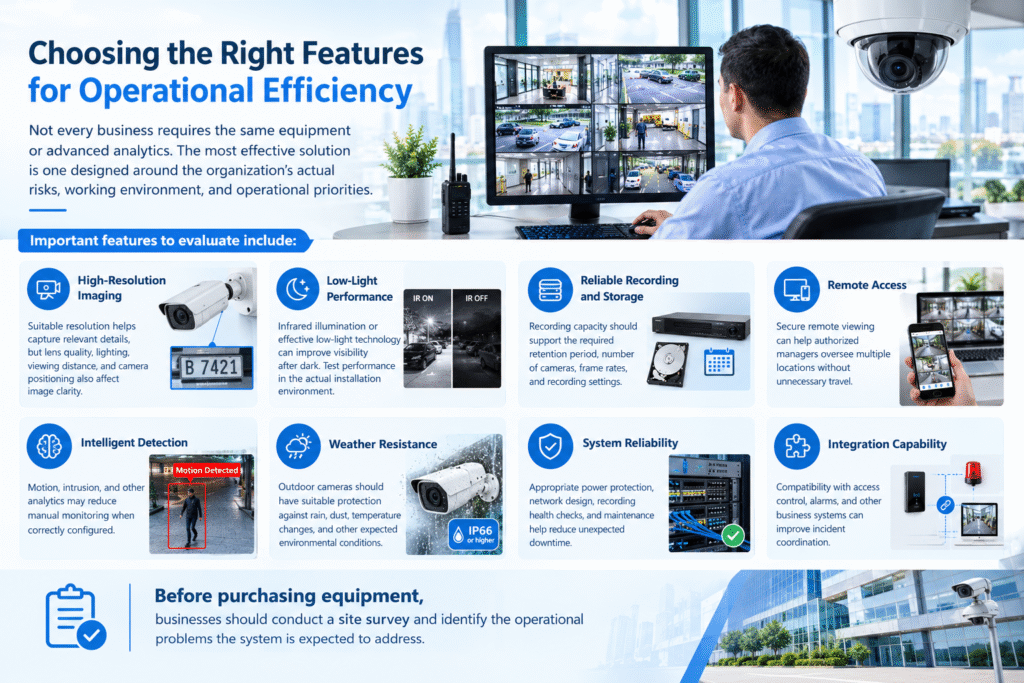
Not every business requires the same equipment or advanced analytics. The most effective solution is one designed around the organization’s actual risks, working environment, and operational priorities.
Important features to evaluate include:
High-resolution imaging: Suitable resolution helps capture relevant details, but lens quality, lighting, viewing distance, and camera positioning also affect image clarity.
Low-light performance: Infrared illumination or effective low-light technology can improve visibility after dark. Test performance in the actual installation environment.
Reliable recording and storage: Recording capacity should support the required retention period, number of cameras, frame rates, and recording settings.
Remote access: Secure remote viewing can help authorized managers oversee multiple locations without unnecessary travel.
Intelligent detection: Motion, intrusion, and other analytics may reduce manual monitoring when correctly configured.
Weather resistance: Outdoor cameras should have suitable protection against rain, dust, temperature changes, and other expected environmental conditions.
System reliability: Appropriate power protection, network design, recording health checks, and maintenance help reduce unexpected downtime.
Integration capability: Compatibility with access control, alarms, and other business systems can improve incident coordination.
Before purchasing equipment, businesses should conduct a site survey and identify the operational problems the system is expected to address.
11. Protecting CCTV Footage and Maintaining System Reliability
A surveillance system provides limited value if cameras fail, recordings are missing, or footage cannot be retrieved when required.
Regular maintenance helps ensure that equipment remains useful over time.
Recommended maintenance activities include:
- Cleaning camera lenses and protective covers.
- Checking camera positioning and viewing angles.
- Confirming that recording is operating correctly.
- Reviewing storage capacity and drive health.
- Testing remote access and authorized user permissions.
- Checking timestamps and recording schedules.
- Updating firmware and applying security patches.
- Testing backup power and relevant network equipment.
- Reviewing retention policies and deleting footage when appropriate.
Cybersecurity is particularly important for network-connected cameras and recorders. Default passwords, outdated software, and unnecessary internet exposure can create opportunities for unauthorized access.
Businesses should restrict access to authorized users, separate surveillance equipment from other networks where appropriate, and maintain a documented process for responding to suspected security incidents.
The CISA guidance for small and medium businesses on logging and monitoring explains how monitoring and reviewing system activity can support the identification of suspicious behavior. While this guidance is broader than CCTV, its security principles are relevant to connected business technology.
12. Respecting Employee Privacy and Using Footage Responsibly
Improving security should not come at the expense of employee dignity or customer privacy.
Businesses should define a legitimate purpose for surveillance, inform employees and visitors where required, restrict access to recordings, and establish clear rules for reviewing and sharing footage.
Cameras should not be installed in areas where people reasonably expect privacy, such as toilets or changing rooms. Audio recording and the use of analytics that identify individuals may also involve additional legal requirements.
Organizations should check the privacy and employment laws applicable to their jurisdiction before installation.
Responsible monitoring focuses on security, safety, incident investigation, and appropriate operational improvement rather than unnecessary surveillance of individuals.
Clear policies help employees understand why cameras are being used and how recorded information will be protected.
13. Measuring the Business Benefits of CCTV
Businesses should evaluate surveillance based on measurable operational outcomes instead of assuming that installing more cameras will automatically improve performance.
Useful indicators include:
- Time required to investigate reported incidents.
- Number and value of recorded inventory discrepancies.
- Frequency of unauthorized access incidents.
- Time spent on unnecessary site visits.
- Duration of operational disruptions.
- Camera and recorder uptime.
- Number of unresolved security alerts.
- Maintenance costs and recurring equipment failures.
For example, a warehouse may record how long it takes to investigate missing stock before installation and compare the results after introducing improved camera coverage and searchable recordings.
A retail business may assess whether better coverage helps resolve delivery disputes more quickly.
Comparisons should account for changes in staffing, reporting procedures, business activity, and other relevant factors. No particular percentage of savings should be assumed without evidence from the organization’s own operations.
14. Practical Steps for Implementing a CCTV Solution
A structured implementation process helps ensure that the technology addresses real business requirements.
Step 1: Conduct a site survey
Inspect entrances, exits, storage areas, workstations, parking facilities, and other locations where security or operational problems occur.
Step 2: Define business objectives
Identify the main goals, such as reducing inventory losses, improving incident investigation, monitoring restricted areas, or reducing unnecessary travel.
Step 3: Design camera placement
Choose suitable camera types, viewing angles, mounting positions, lighting arrangements, and network connections based on the site’s requirements.
Step 4: Plan recording and storage
Determine how many days footage must be retained and select suitable recording equipment and storage capacity.
Step 5: Configure access and alerts
Assign appropriate permissions to managers, security staff, and other authorized users. Configure event notifications according to operational needs.
Step 6: Train employees
Explain relevant surveillance policies, incident-reporting procedures, privacy requirements, and responsibilities for handling recordings.
Step 7: Test and maintain the system
Verify image quality, recording, playback, remote access, time synchronization, and alerts before treating the system as operational. Schedule regular checks afterward.
Following these steps helps businesses avoid common problems such as blind spots, inadequate storage, excessive notifications, and poorly secured remote access.
Operational efficiency depends on the ability to identify problems quickly, protect valuable assets, maintain safe working conditions, and make informed decisions. When designed and managed correctly, surveillance technology can support all these objectives.
A modern CCTV system can help businesses reduce investigation time, improve visibility across facilities, support inventory control, monitor restricted areas, and identify operational weaknesses. Remote viewing and intelligent analytics may further reduce repetitive monitoring tasks and help managers respond to relevant events more efficiently.
However, cameras alone cannot eliminate operational risk. The best results come from combining suitable equipment with reliable maintenance, employee training, secure access controls, responsible data handling, and clear incident-response procedures.
Businesses should begin by identifying their most costly security and workflow problems, then design a surveillance solution that addresses those needs. By measuring results over time, organizations can determine whether their investment is genuinely reducing wasted time, improving accountability, and supporting more reliable daily operations.
Ultimately, effective CCTV planning is not just about recording what happens. It is about using reliable visual information to help people manage risks, investigate problems, and keep business operations running smoothly.